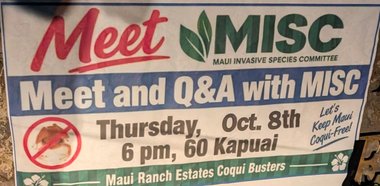
 Coquí Busters: Thu Oct 8, 6pm at 60 Kapuai Rd. Talk story with MISC and see how they are supporting our efforts.
Learn more →
Coquí Busters: Thu Oct 8, 6pm at 60 Kapuai Rd. Talk story with MISC and see how they are supporting our efforts.
Learn more →
Coquí Busters: Thu Oct 8, 6pm at 60 Kapuai Rd. Talk story with MISC and see how they are supporting our efforts.
Learn more →
Coquí Busters: Thu Oct 8, 6pm at 60 Kapuai Rd. Talk story with MISC and see how they are supporting our efforts.
Learn more →
Neighborhood Effort
Neighbors working together to push back the coquí frog, on both sides of the HOA line
The coquí is a small frog, native to Puerto Rico, with a very loud, piercing, two note call, co-KEE, that it repeats through the night. A dense infestation is not a background sound, it is a wall of noise that carries through closed windows and takes away the quiet that most of us moved up here for. Coquí have been established on Maui for roughly twenty five years, and Haʻikū holds the island’s largest population.
The Maui Invasive Species Committee (MISC) has fought the frogs here since the beginning, but in mid July MISC announced that its crews would no longer treat residential property inside the most heavily infested part of Haʻikū. Residents in that area now have to apply citric acid themselves. MISC is concentrating what is left of its capacity on stopping the spread into new areas. That is a defensible choice on their part, and it means the work in our neighborhood now falls to the people who live here.
A lesson from other Maui neighborhoods is that working alone does not hold ground. Frogs do not respect property lines and will move back in from an untreated lot next door. Pushing them back takes neighbors working the same area at roughly the same time.
To this end a group is being organized across the neighborhood to deal with our local infestation. Neighbors on adjacent streets outside the HOA are welcome, and the effort will not succeed without them.
The heaviest infestation in Maui Ranch Estates is at the end of N. Lanikai, moving up the eastern gulch toward S. Lanikai, and moving over to Kapuai Rd. They have crossed Kapuai and are working their way toward Waipalani Rd. The goal is to stop them before they go any further west.
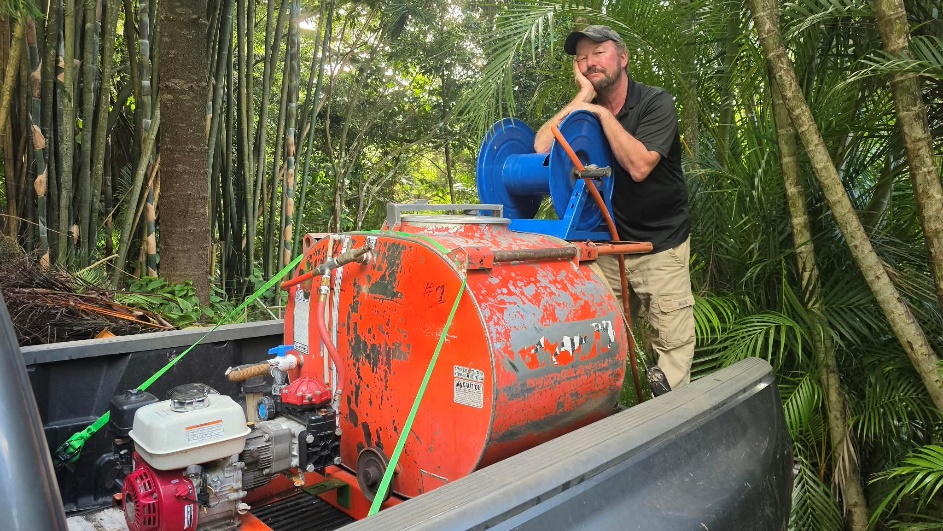
Todd Johnson feeling tankful.
If you are able, consider buying your own sprayer. Coquí management takes repeated treatment rather than one pass, and having your own equipment means you can work your lot whenever you need to instead of waiting for a turn.
If you need training in how to hand catch or how to spray, come to one of the group’s meetings and someone will walk you through it.
If you have been treating your property already, keep going. If you have been thinking about starting, now is the time. Managing coquí is a long effort and it depends on neighbors working the same ground at roughly the same time.
Aaron Lisco, a resident at 60 Kapuai, has volunteered to lead the effort, which is calling itself the Coquí Busters. The group has begun meeting to compare notes on what actually works here and to plan coordinated work. They are requesting help from the community. Owners and renters can both pitch in.
If you are fighting frogs on your lot, or are willing to start, get in touch with the group directly.
Coquí Busters
coquibusters.mre@gmail.com
Aaron Lisco
808.868.6782
Because the frogs cross property lines, the group will need to work across neighboring parcels. Nobody will enter your property without your permission. If you are willing to have the group work on your land, say so. You can set limits on where and when, and you can withdraw permission at any time. If you would rather they did not, that is ok, and it helps to know, so the group can plan around your lot.
If you are wondering about your own liability for letting volunteers onto your land, Hawaii law addresses this directly. Chapter 520A of the Hawaii Revised Statutes, Landowner’s Liability for Access to Control Invasive Species, limits the duty of care an owner owes to someone permitted onto the property to control or eradicate invasive species. It applies where the owner permits the access without charge, which is the case here. The protection is not unlimited. It does not cover willful or malicious failure to warn about a dangerous condition on the property that the owner knows about. If you have a hazard on your land, tell the group about it before they come.
The standard treatment is a citric acid solution sprayed on frog habitat. Catching them by hand works too, and a 365nm UV light helps, because their eyes shine back at you. Spraying by day works as well as working at night. MISC provides the acid powder at no cost.
Caution: the citric acid solution is a severe eye irritant and a moderate skin irritant. It is not hazardous the way a pesticide is, but it is not harmless either. Wear eye protection, gloves, long sleeves and long pants while spraying. If you are working where someone has recently sprayed, wear gloves and let the foliage dry before handling it. Follow the guidance that comes with the equipment, especially directions to rinse the corrosive acid from the machine.
Cutting back overgrown vegetation matters as much as spraying. Frogs shelter in dense growth, and a thinned out understory both holds fewer frogs and lets spray reach the ones that remain. Areca palms, ti and bromeliads are favorite homes, and all three are everywhere in our area. Ground litter is where the frogs shelter during the day, and they climb up into the growth at night. If you can remove the habitat, you reduce the infestation.
MISC has not walked away from residents, it has changed what it does for them. Through its Community Coquí Control Program it offers training, premixed citric acid solution, and sprayers on loan, from backpack units up to larger ones. The labor and the transportation are ours. MISC is stretched thin and some of its equipment is out of service, so what is available on any given week is worth asking about rather than assuming.
Information on MISC’s efforts, including video demonstrations, is at MISC’s Community Coquí Control Program page. Be aware that this page may contain outdated information about MISC’s ability to assist.
For background on where things stand across Haʻikū, see “Haʻikū residents urge more action against coquis,” The Maui News, August 6, 2026.
This is a neighbor led effort, not an Association program. It deliberately includes households outside the HOA, as the frogs do not stop at the subdivision boundary and neither can the response.
At its August 5 meeting the Board heard Aaron’s presentation and was supportive, and said it would consider helping the effort financially, possibly toward spraying equipment. No amount has been committed and no vote has been taken on funding.
The Association does not share your name, address, phone, or email with other residents or with outside parties without your permission. The Coquí Busters email above is a group address, and Aaron’s phone number appears because he asked that it be published. If you would like to be connected with neighbors working on this and would rather not reach out yourself, let the Board know and we will pass a message along. We do not hand out contact lists.
If you hear a coquí on your property and cannot get rid of it on your own, the Coquí Busters will put you on the schedule. Use the link below and tell us your name, your address, and how to reach you. You can use the same link to volunteer, to ask for training, or to give the group permission to work on your land.
You can also write to coquibusters.mre@gmail.com yourself, or call Aaron Lisco at 808.868.6782.
Sign up by email